
Date.
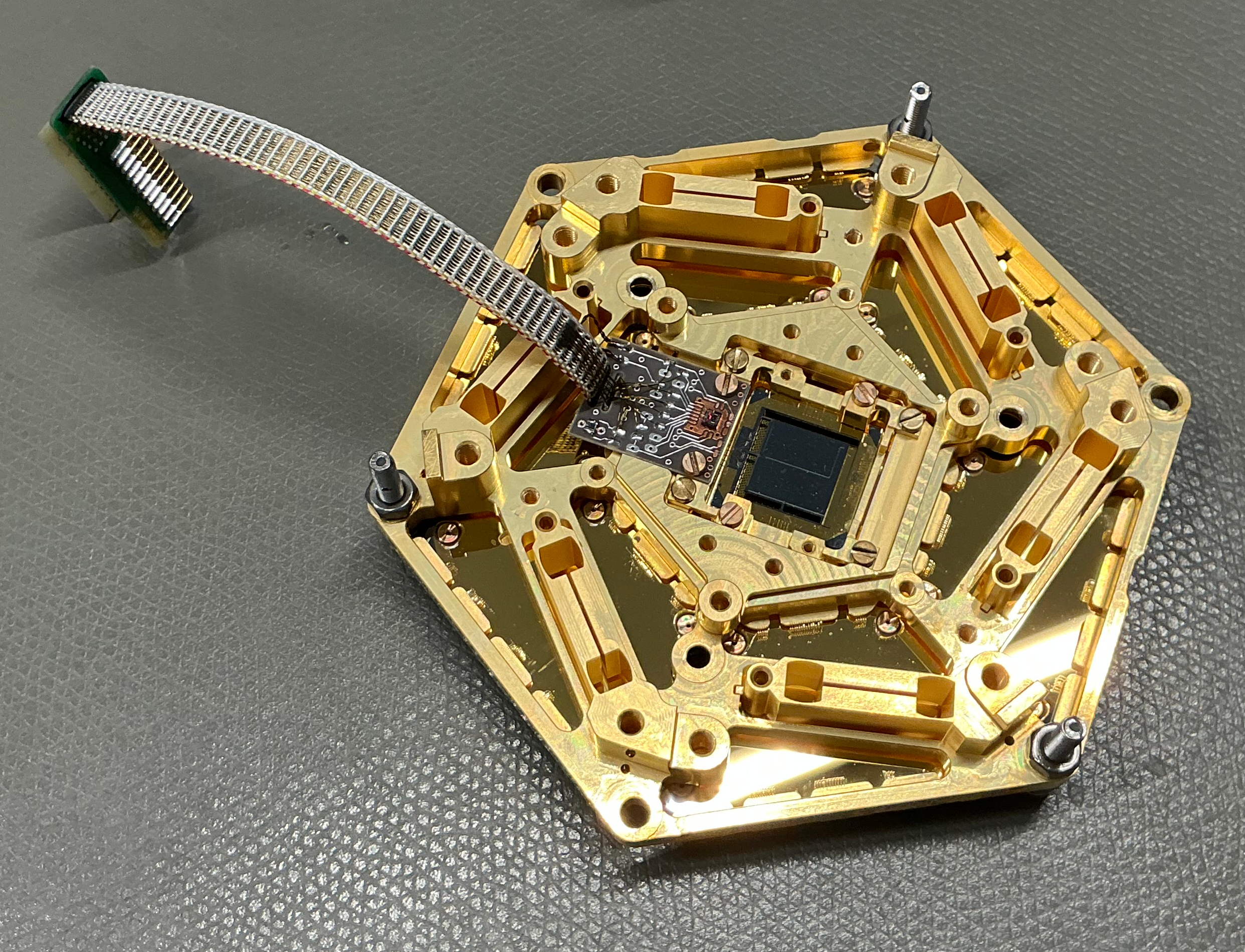
Image above : The CryoAC demonstration prototype integrated in the detectors flange of the Focal Plane Assembly Demonstration Model 1.1. Image credit: SRON.
The X-ray Integral Field Unit (X-IFU) is the cryogenic instrument onboard NewAthena mission. In the late 30s, it will transform our understanding of the hottest components and the most energetic phenomena in the Universe. At the heart of the instrument is an array of Transition Edge Sensor (TES) detectors, which operate at a temperature of just 50 thousandths of a degree above absolute zero.
However, the TES array alone cannot distinguish celestial X-ray photons from the background particles present in the spacecraft orbit. Without shielding, these particles would significantly degrade the instrument sensitivity, making it impossible to achieve the mission ambitious objectives. To address this issue, the X-IFU exploits the Cryogenic AntiCoincidence Detector (CryoAC), a TES based active shielding system working at the same temperature of the TES array. It can efficiently detect background particles, thus allowing their signals to be filtered out.
The CryoAC is being developed by an Italian consortium led by INAF/IAPS, which includes the University of Genova (production of the detector chip), the CNR/IFN Roma (design of the warm and cold electronics) and ASI (funding, product assurance and project management). Its readout chain is based on a SQUID amplifier supplied by VTT. The detector design is driven by detailed Monte Carlo simulations, which estimate the expected background level for the X-IFU during the flight. To achieve the required particle rejection efficiency of ~ 98%, the simulations show that the CryoAC must be mounted less than 1 mm below the TES array. Given this close proximity, ensuring mechanical, thermal and electromagnetic compatibility between the two detectors presents a big challenge in the X-IFU development.
To demonstrate the proper simultaneous operation of the TES array and the CryoAC is one of the main goal of the X-IFU Demonstration Model 1.1 campaign. At the end of October, the joint test between the detectors have been started at SRON, where the Focal Plane Assembly DM1.1 (i.e. the core cold part of the X-IFU) has been for the first time assembled and cooled down to 50 milliKelvin. In this setup, the CryoAC and the TES array Demonstration Models are mounted only 0.65 mm apart.
The results obtained during the first week of testing are really encouraging. The CryoAC operations did not affect the performance of the TES array, which is required to achieve a breakthrough spectral resolution of less than 4.0 eV at 7 keV. In fact, the TES array retained the same spectral resolution measured before the insertion of the CryoAC. At the same time, the CryoAC DM has shown performances fully compliant with its requirements, demonstrating a low energy detection threshold < 6 keV (requirement < 20 keV), ensuring low power dissipation on the cold stage and no significant magnetic emission affecting the TES array. Finally, the vetoing capability of the system has been demonstrated through the simultaneous detection of particle signals on both detectors. These rare events, approximately one count per day per TES array pixel on the Earth, are due to muons generated by cosmic-rays impacting the atmosphere and are representative of background events that the instrument will experience during flight (but with a flux ~200 times higher there!).
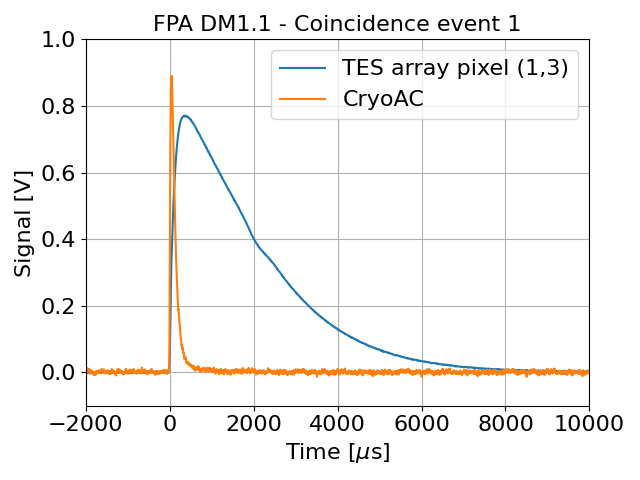
Coincident signals detected on TES array and CryoAC, due to a cosmic muon interaction with the FPA DM1.1. Both detectors are microcalorimeter, thus their response to a particle interaction is a pulse with amplitude proportional to the deposited energy. Note that the pulses start is perfectly synchronized while the decay time is different, due to different design of the devices. Image credit: INAF/IAPS.
This has been the first time that the TES array and CryoAC have been operated together since the X-IFU instrument was redesigned to be operated by the Time Division Multiplexing (TDM) readout system developed by NASA, NIST and APC, and the first test in a representative Focal Plane Assembly setup.
The success of this campaign is good news for the XIFU development, and a fundamental step towards the NewAthena launch!

 LinkedIn
 X (ex-Twitter)
 Youtube