
Everything you’ve ever wanted to know about the X-IFU is right here.
The X-ray Integral Field Unit (X-IFU)
The X-IFU is a revolutionary X-ray spectrometer.
It is the one of the two instruments of the European Space Agency’s future space telescope, NewAthena (Advanced Telescope for High Energy Astrophysics). With its X-ray eyes, the X-IFU will observe the hot and energetic Universe, a world of clusters of galaxies, black holes, and exploding stars.
A revolutionary X-ray spectrometer
The X-IFU combines high spectral resolution with high quality imaging.
In other words, the X-IFU will be able to capture images of astrophysical objects in which each pixel of the image will provide us with a full spectrum containing a lot of information about the objects.
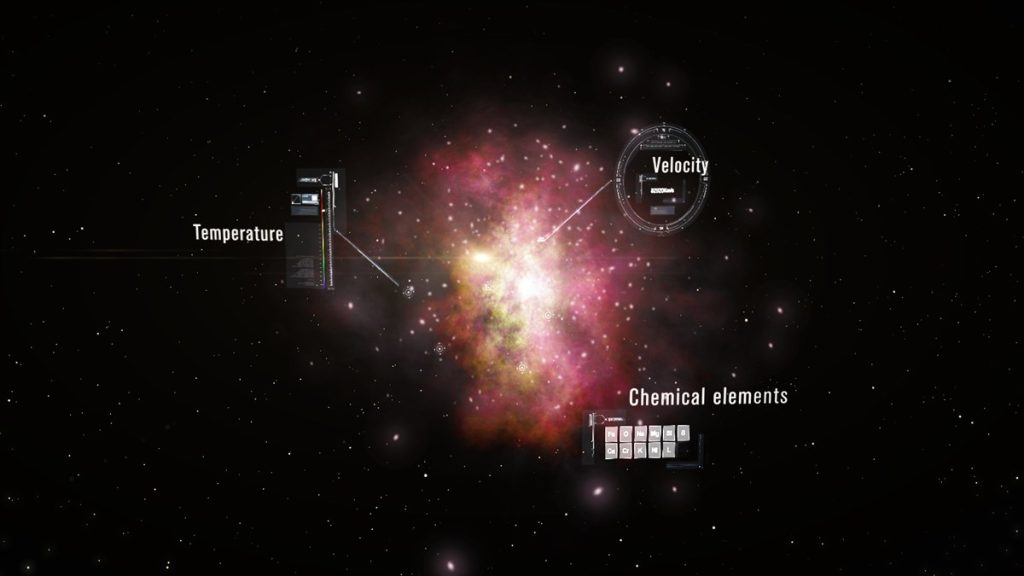
Thanks to its unprecedented capabilities, this revolutionary X-ray spectrometer will enable astrophysicists to answer some of our most burning questions about the Universe. They will extract breakthrough information about the formation and evolution of the large structures of matter observed in the Universe. For instance, they will measure the abundance of different elements (oxygen, iron, tin, etc.) within galaxy clusters.
They will also expand our knowledge about the birth and life of black holes, along with how they interact with the galaxies in which they live. For example, they will measure with a higher degree of precision than ever before the speed at which a black hole spins.
An array of thousands of micro-calorimeters
Cutting-edge technologies will allow the X-IFU to accurately measure the energy of the X-rays that are collected by the telescope mirror.
1. Absorb an X-ray
The instrument uses micro-calorimeters: highly sensitive heat sensors capable of measuring the tiny amount of heat released when an X-ray is absorbed.
2. Cool the detectors
Thousands of these micro-calorimeters are assembled together. They are cooled to nearly absolute zero (-273,1°C / 50mK) by a complex cooling chain to increase their sensitivity to slight variations in temperature.
3. Read the signal
The temperature increase measured by the micro-calorimeter is converted by superconducting thermometers into an electrical signal that is read out by high-precision electronics. The signals are individually analysed to accurately estimate the energy of each X-ray photon, giving access to the conditions in which they were emitted.
Inside the instrument
Explore the sub-systems that make X-IFU possible.
An international collaboration
The X-IFU is developed by an international consortium, coordinated in France by IRAP, the research institute in astrophysics and planetology, and CNES, the French space agency. The X-IFU consortium gathers around 300 engineers and researchers, a number that will keep increasing as we get closer to the launch.
They are spread across 12 countries, 11 ESA members states (Belgium, Czech Republic, Finland, France, Germany, Ireland, Italy, the Netherlands, Poland, Spain, and Switzerland), and the United States (NASA).

The NewAthena mission
NewAthena (Advanced Telescope for High-Energy Astrophysics) is ESA’s next-generation X-ray observatory and the second large-class mission of its Cosmic Vision programme. As the successor to ESA’s XMM-Newton and NASA’s Chandra, and following JAXA’s XRISM (X-ray Imaging and Spectroscopy Mission), NewAthena will carry two instruments: the X-IFU (X-ray Integral Field Unit) and the WFI (Wide Field Imager), which will survey the X-ray Universe. Its movable and tilting mirror assembly will allow the telescope to switch focus between the two instruments.
NewAthena’s mirror system will deliver unprecedented effective area with fine spatial resolution over a large field of view
Three key characteristics that maximize scientific discoveries :
Effective area
The surface area over which photons from astrophysical sources are collected and directed toward the focal plane instruments.
Spatial resolution
The ability to distinguish and separate two nearby astrophysical sources.
Field of view
The region of the sky that can be imaged by the instruments.
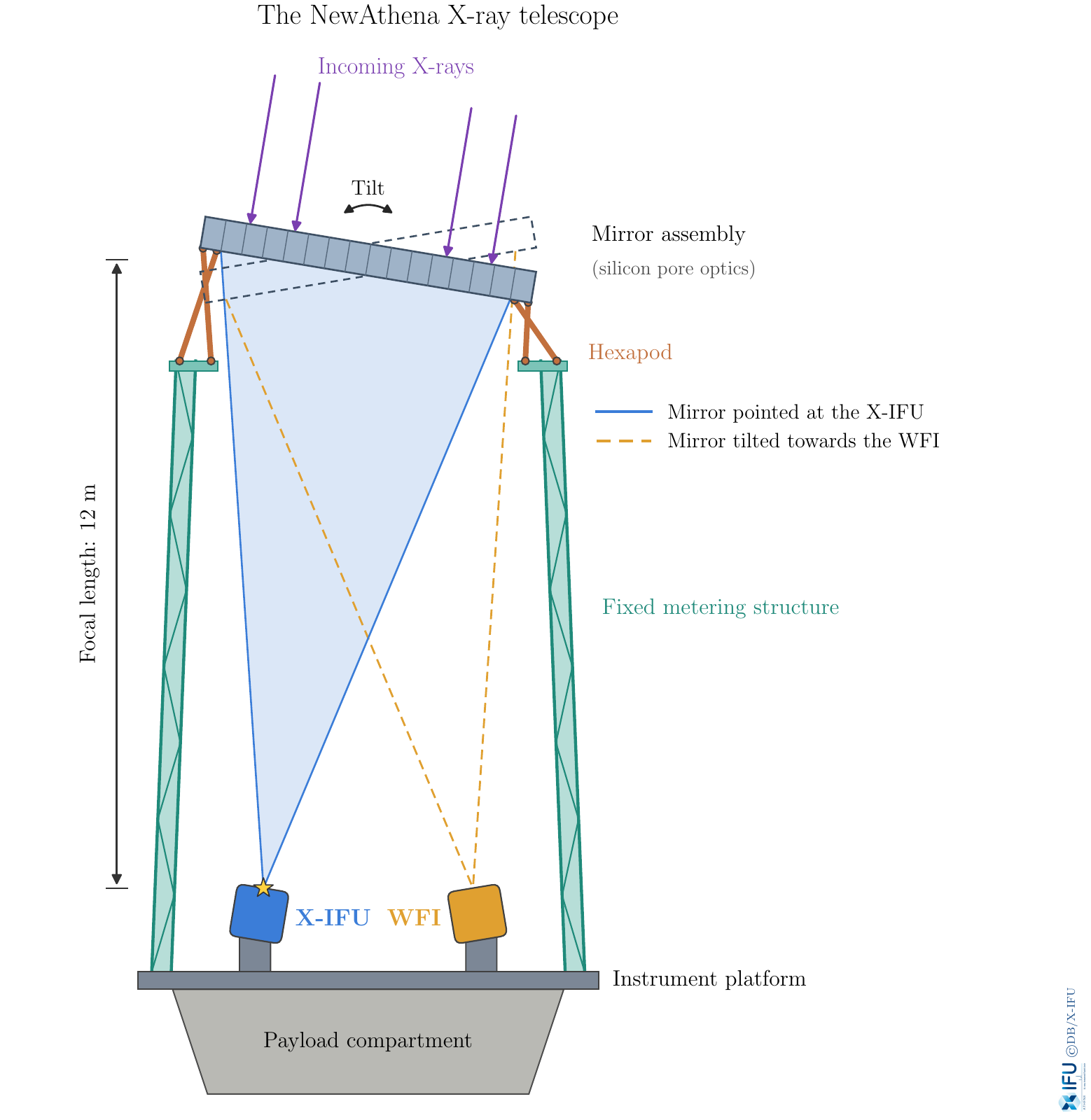
By combining these three features, NewAthena will push the boundaries of X-ray astrophysics. The mission is scheduled for launch at the end of the next decade aboard Ariane 6, with a minimum operational lifetime of 5 years and a design lifetime of 10 years.