

Building an instrument like the X-IFU spectrometer, as well as preparing for the scientific discoveries it will enable, requires a strong international partnership.
We present below the various groups that form the X-IFU Consortium.
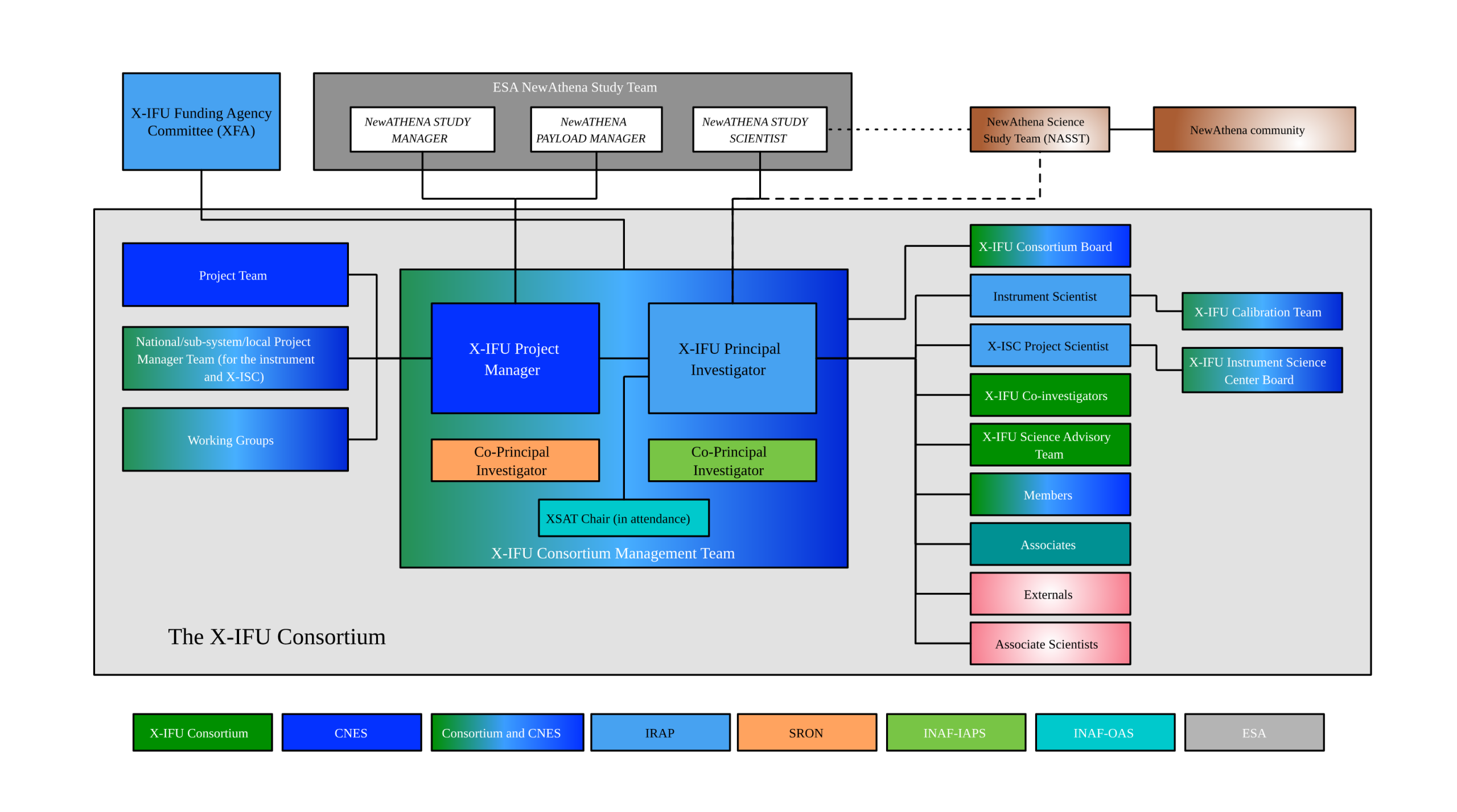
View the detailed X-IFU organisation chart
Consortium personnel
The X-IFU consortium has four categories of personnel.
Members
Members contribute to the development of the instrument or its ground segment with funding from an ESA member state, which earns their country access to the guaranteed time.
Associates
Associates also have a defined role, but they come from industry, partner countries or ESA, and their contribution is rewarded through other channels.
External contributors
External contributors carry out exploratory work that is not part of the baseline instrument.
XSAT support scientists
XSAT support scientists provide, on a temporary basis, expertise the XSAT does not otherwise cover.
Co-Investigators
Co-Investigators are scientists and engineers with specific responsibilities and a sustained, nationally funded commitment to the X-IFU.
They are either Science Co-Is or Instrument Co-Is, depending on their main role. Eventually, there may be up to about 100 Co-Is, with balance sought between nationalities and genders.
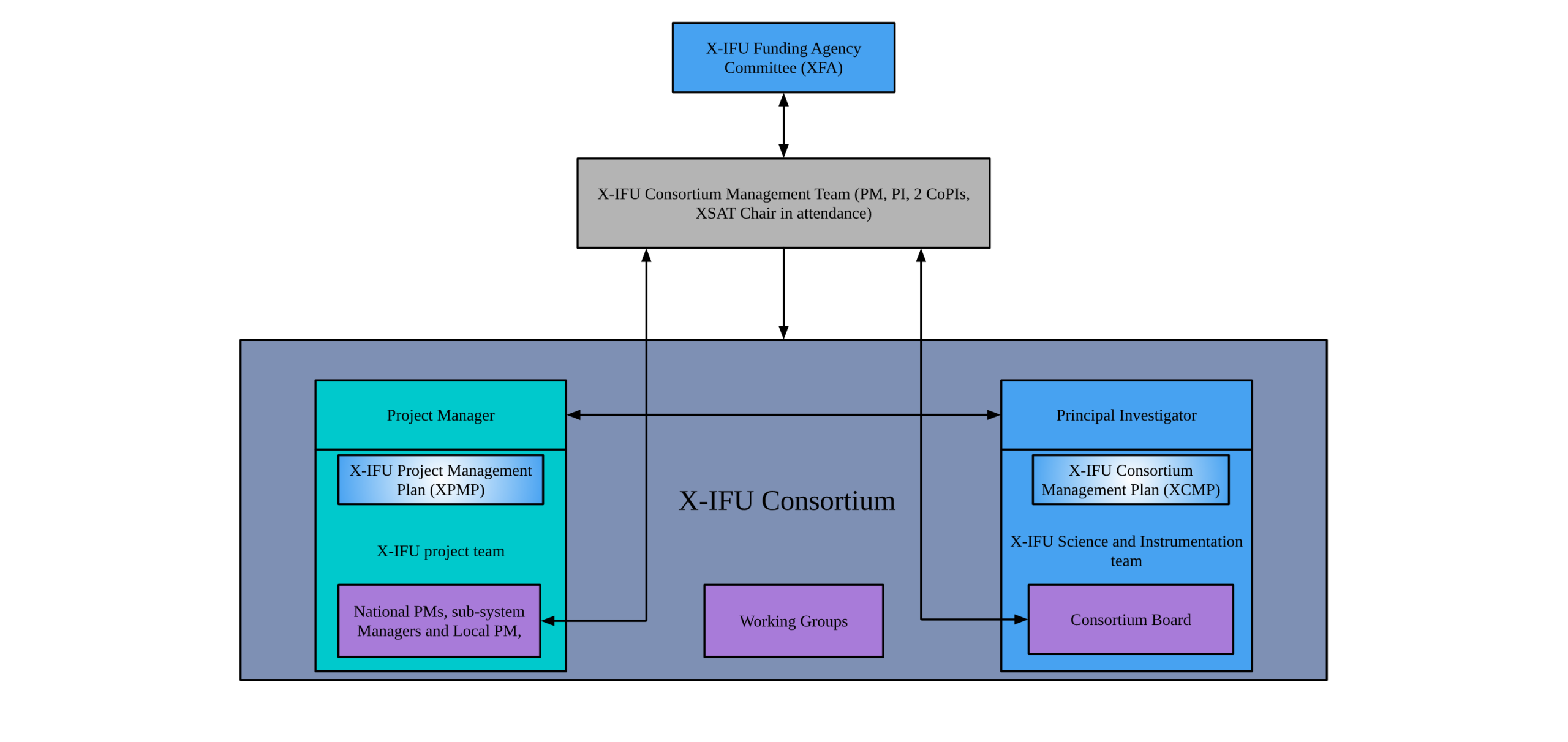
X-IFU Consortium Management Team (XCMT)
The XCMT is the governing body of the X-IFU consortium. It is co-chaired by the PM and the PI, and its other members are the two Co-PIs, with the XSAT Chair attending.
Decision process
It must agree to all major scientific, technical and programmatic decisions, and it decides by consensus.
Arbitration
Unresolved issues are referred for arbitration to the XFA, which has one funding agency representative per partner country.
X-IFU Consortium Board (XCoB)
The XCoB links the consortium leadership with the participating institutions and funding agencies of the partner countries. Its members represent their national communities, act as contacts with their funding agencies and ESA SPC delegates, and discuss the consortium’s high-level scientific, organizational and programmatic issues.
Consortium Board members serve as the consortium interface for the national contributions, but they have no authority to provide agency concurrence or make agency commitments.
X-IFU Science Advisory Team (XSAT)
The XSAT is a team of up to 30 scientists that advises the PI on all scientific aspects of the X-IFU. It assesses the science impact of design or performance changes, helps turn the mission’s science requirements into instrument specifications, contributes to the guaranteed time program, and promotes X-IFU science.
Its composition balances countries, science areas and genders.
X-IFU Calibration Team (XCaT)
The XCaT is a team of scientists and engineers, chaired by the X-IFU Instrument Scientist, that handles the ground and in-flight calibration of the X-IFU. The calibration plan is approved by the PI and the PM.
X-IFU Instrument and Science Center (X-ISC)
The X-ISC is the consortium’s contribution to the NewAthena Science Ground Segment, which ESA leads. Its development is led by a CNES System Lead on behalf of the PM, and its science by an IRAP Project Scientist on behalf of the PI, with the support of the X-ISC Board.
X-ISC Board
The X-ISC Board supports the X-ISC Project Scientist and System Lead, who co-chair it, on scientific, technical and organizational matters. It decides by consensus.
Issues it cannot resolve, and programmatic issues on the X-ISC development, are referred to the PI and PM, and from there to the XCMT and the XCoB if needed.
Working Groups (WGs)
Working Groups bring the consortium’s expertise to the CNES project team and work under the responsibility of the PM.
Each is preferably co-led by one member of the CNES project team and one consortium member. WGs are kept small, and their membership depends on the expertise each one needs.