Go-ahead for Athena
On Wednesday November 8, 2023, ESA’s Science Programme Committee (SPC) formally and unanimously approved the restart of industrial studies for the Athena mission, still considered as a flagship mission.

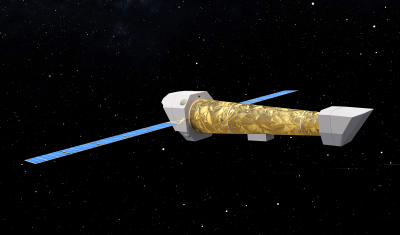
On Wednesday November 8, 2023, ESA’s Science Programme Committee (SPC) formally and unanimously approved the restart of industrial studies for the Athena mission, still considered as a flagship mission.
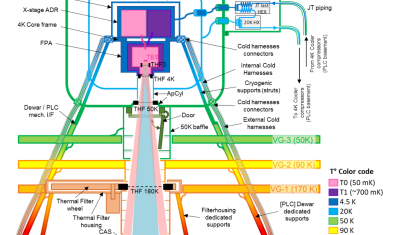
Following the necessity to bring the ESA Cost at Completion below €1.3 billion, the Athena mission and the X-IFU have entered a reformulation phase in 2022.
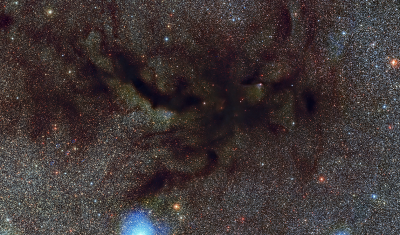
Image credit: © ESO The astronomer Carl Sagan once said: “We are made of stardust”. This is, to a large extent, true. The building blocks of our planet and all the living creatures are made of elements, as for example carbon, oxygen and iron, that are forged during the star cycle. The last phases of […]
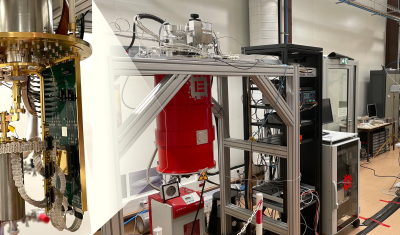
The test platform developed by IRAP and CNES in Toulouse is a key element of the demonstration of the detection chain electronics developed in France for the Athena X-IFU. Within this platform, prototypes of flight electronics will be included in an end-to-end detection chain covering from the transition-edge sensor (TES) microcalorimeters to the X-IFU data […]

All the galaxies in the Universe host a supermassive black hole of unknown origin at their center and the mass of the black hole…
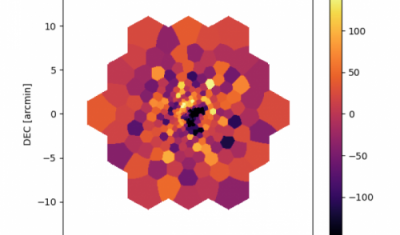
Clusters of galaxies are the largest bound astrophysical objects in the Universe. Located at the nodes of the cosmic web, they are huge gravitational potential wells of masses about 100 to 1000 trillion times that of the Sun, filled with around 85% of dark matter and 15% of ordinary (baryonic) matter. The latter is for […]
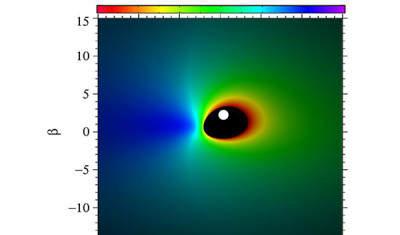
Active galactic nuclei (AGN) are bright compact regions located at the centres of some galaxies. These objects are powered by the accretion of gas, through a disc, onto a supermassive black hole (~105-109 Msun) . The accretion disc emits the bulk of its light in the ultraviolet/optical range. The disc photons will then be Compton […]
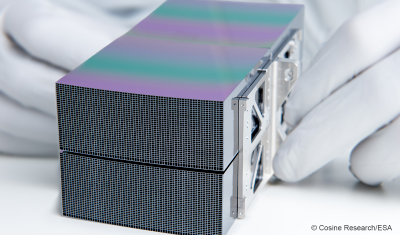
The Athena mirror will use an innovative technology called Silicon Pore Optics (SPO). The technology, combined with appropriate over coating, holds great potential to meet the Athena performance requirements in terms of effective area. The SPO have to match several top-level performance requirements. The most driving ones are the angular resolution and the effective area. […]
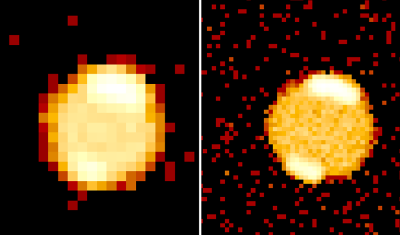
It was just over 40 years ago when Jupiter’s X-ray aurora was discovered with the Einstein Observatory. Since then, we have come an exceptionally long way in exploring the solar system in X-rays, with XMM-Newton and Chandra playing a major role over the last 20 years. Since 2016 and the arrival of JUNO at Jupiter, […]